Brain Based Safety & Human Risk Advisory
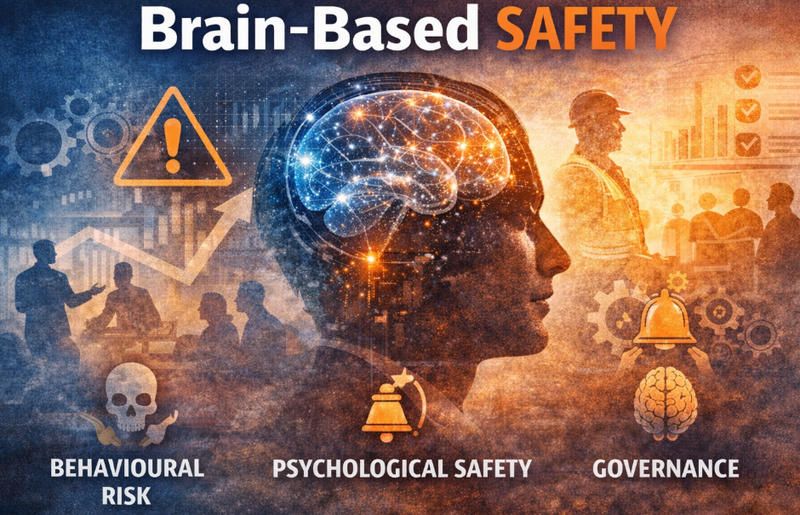
Brain-Based Safety Consultancy
Harnessing Neuroscience, Behavioural Risk and Governance to Improve Safety Performance
Traditional work health and safety systems place strong emphasis on compliance, policies and procedures. While these are essential, they do not fully explain why capable, well-intentioned people still take unsafe risks, remain silent, or make poor decisions under pressure.
This service exists to address the human cause of safety failures that compliance can't fix.
Robust Leaders’ Brain-Based Safety Consultancy integrates neuroscience, psychology, governance and risk management to help organisations understand and address the human factors that drive safety outcomes in real operational environments.
This is not wellbeing coaching. It is preventative risk and governance work, grounded in neuroscience human factors and WHS obligations.
What Problem This Service Solves
Safety failures are rarely caused by people choosing to be unsafe.
They are more often the predictable result of:
Cognitive overload and time pressure
Fatigue and sustained stress
Authority gradients that discourage speaking up
Competing operational priorities
Systems that appear sound on paper but fail under real conditions
When these conditions exist, unsafe decisions, silence and workarounds become more likely — even in mature organisations with strong intentions.
This service identifies where those conditions exist, why they create risk, and what needs to change at system level so safety does not rely on individuals compensating for flawed design.
What You Receive
When you engage Robust Leaders, you receive:
A Human Risk & Decision-Making Risk Assessment focused on real work conditions
A written, governance-ready report identifying where systems, leadership and pressure are creating foreseeable risk
Clear, prioritised recommendations to reduce risk at system level
Practical guidance leaders can act on immediately
Documentation that supports due diligence, accountability and defensibility
Clients consistently report that this work reveals risks that were invisible in audits, dashboards and incident data, but obvious once harm occurred.
How the Assessment Is Conducted
The assessment is a structured, evidence-based diagnostic focused on how decisions are actually made under real operating conditions.
It does not assess individuals.
It assesses systems, leadership and conditions.
1. Risk Context and Decision Mapping
We begin by understanding where safety failure would have the greatest consequence and where decision-making is most pressured or ambiguous.
This includes reviewing:
Incident patterns and near-miss narratives
Organisational and governance structures
Areas where judgement, trade-offs or discretion are relied upon
This phase defines the risk lens for the assessment.
2. Work as Experienced in Practice
We examine how work is actually done — not just how it is designed.
Using structured conversations, task walk-throughs and scenario-based questioning, we assess:
Cognitive load and interruptions
Time pressure and fatigue exposure
Informal workarounds and shortcuts
Where reporting stops or becomes selective
How competing priorities are resolved in practice
This identifies where system design unintentionally pushes people toward unsafe decisions.
3. Cognitive Load and Human Limits
Drawing on neuroscience and human factors, we analyse how stress, fatigue, threat and overload affect attention, judgement and decision-making at critical points.
We identify where expectations placed on people exceed realistic cognitive capacity — particularly under pressure — making error, silence or risk-taking more likely.
This explains unsafe behaviour without excusing it, allowing risk to be addressed at its source.
4. Leadership Signals and Authority Gradients
Leadership behaviour strongly shapes what people believe is safe to say or do.
We examine:
How leaders respond to bad news, uncertainty and competing priorities
What behaviours are rewarded or discouraged
Where authority makes pausing, questioning or escalating risk harder
This analysis reveals how leadership unintentionally increases or reduces risk through everyday signals.
5. Governance and Risk Design Review
We review how safety and risk decisions are governed, including:
Where accountability and authority sit
How psychosocial and human factors risks are recognised
Whether due diligence considers foreseeable human limitations
This phase ensures findings are framed in a way that is legible to boards, regulators and insurers, not just safety teams.
6. Synthesis and Risk Prioritisation
Findings are integrated to identify predictable failure pathways — where system design, leadership and cognitive constraints intersect to create risk.
Rather than listing issues, we prioritise:
What creates the greatest exposure
What must change first
What can be simplified, redesigned or removed
The focus is always on preventing harm upstream, not reacting after the fact.
Key Outputs
Clients receive:
A Human Risk & Decision-Making Risk Report suitable for board and executive review
A clear map of where risk is being created and why it is foreseeable
Practical system-level recommendations across leadership, governance, work design and reporting
A defensible narrative that demonstrates proactive consideration of human factors and duty of care
When Organisations Engage This Service
This advisory is typically engaged when organisations:
Experience repeated incidents despite strong safety systems
Recognise leadership behaviour is influencing safety outcomes
Face increasing psychosocial or human factors risk
Want stronger due diligence and governance defensibility
Operate in high-pressure or high-risk environments where decisions matter
In Practice
This service supports organisations to move from reactive safety management to deliberate, human-centred risk control, where systems, leadership and governance are aligned with how people actually think and decide under pressure.
People do not simply choose safe behaviour.
Behaviour is shaped by the conditions in which decisions are made.
Robust Leaders helps organisations design those conditions deliberately.