When Inclusion Creates Fear
By Rose Byass
Inclusion Was Meant to Reduce Harm — Not Create It
Diversity and inclusion initiatives were introduced into workplaces with good intentions: to reduce discrimination, create fairer environments, and ensure people of all backgrounds could participate safely and meaningfully at work.
Yet across many organisations, a quiet tension is emerging.
Not tension between minority groups and leadership — but tension within the broader workforce, where employees increasingly report uncertainty, fear of saying the wrong thing, and reluctance to speak honestly.
This is not opposition to inclusion.
It is confusion about how inclusion is being operationalised.
And when confusion meets fear, psychological safety deteriorates.
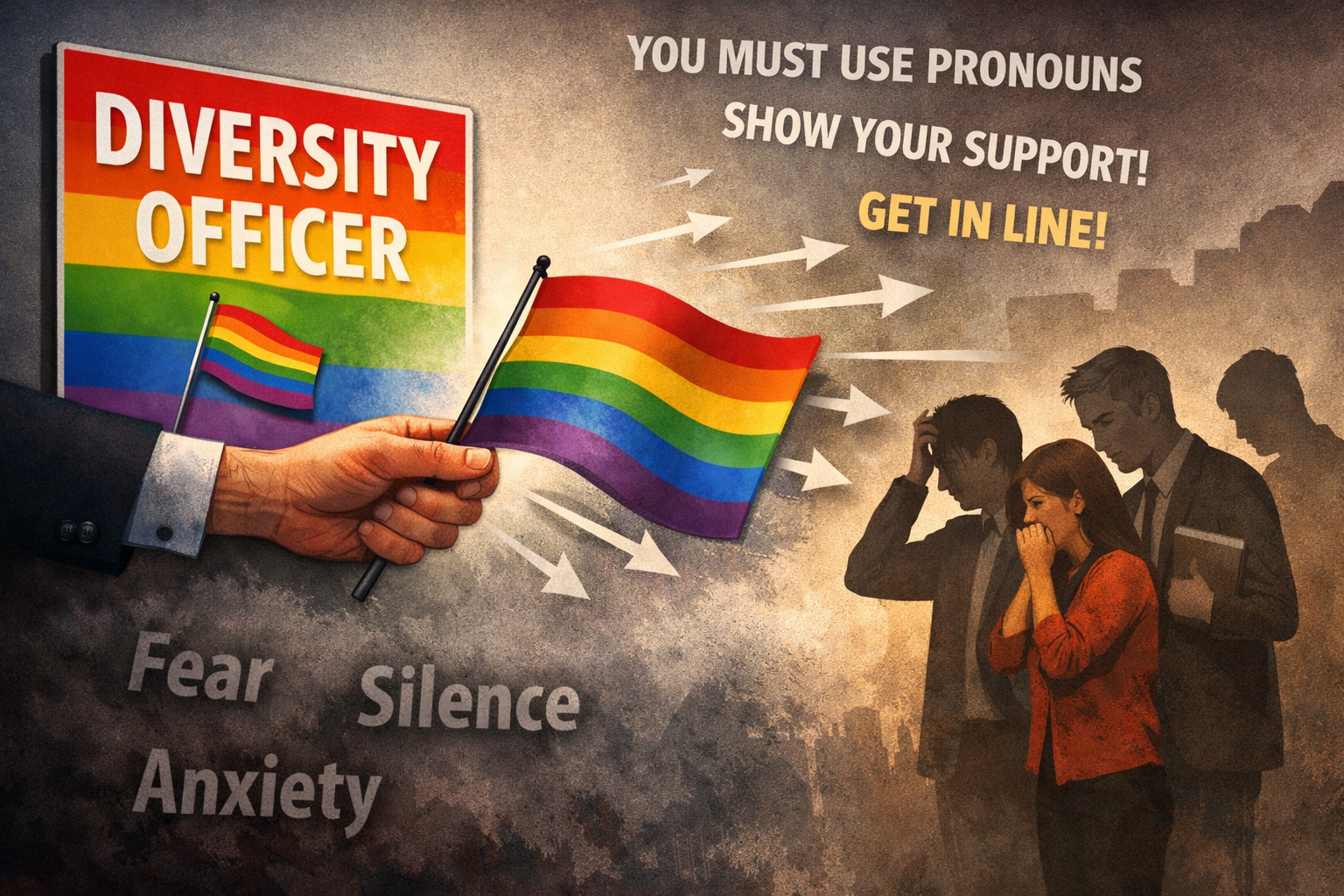
In some organisations, the introduction of Diversity or Inclusion Officers has unintentionally shifted the workplace from one of shared behavioural expectations to one of ideological compliance, where people feel required — not invited — to adopt specific language, beliefs, or public expressions of support. This article explores how well-intentioned diversity frameworks, when implemented without governance discipline, neuro-safety awareness, or risk controls, can become psychosocial hazards themselves.
Psychological Safety: A Systemic Condition, Not an Ideological Outcome
Psychological safety, as defined in organisational research, is the belief that one can speak up, ask questions, express uncertainty, or make mistakes without fear of punishment, humiliation, or exclusion.
It does not require agreement.
It does not require uniform beliefs.
It does not require emotional endorsement of organisational values. It requires predictability, fairness, and safety in interpersonal risk-taking. From a neuroscience perspective, psychological safety exists when the brain does not perceive threat in social interaction — threat to reputation, employment, belonging, or identity. When threat is perceived, the brain defaults to:
- Silence
- Compliance without engagement
- Avoidance
- Withdrawal
These are automatic neurological responses, not moral failures.
The Emerging Problem: When Inclusion Is Enforced Rather Than Enabled
In some workplaces, inclusion initiatives have shifted from protecting people from harm to directing how people must think, speak, or publicly align. Examples reported across organisations include:
- Mandatory declaration of pronouns in meetings or email signatures
- Required participation in symbolic displays (lanyards, badges, public affirmations)
- Pressure to openly advocate for specific social movements
- Fear that questioning or misunderstanding language norms will result in reputational or disciplinary consequences
For some employees, particularly those outside LGBTQIA+ communities, this creates a new psychological dilemma:
“If I don’t understand this — or if I ask the wrong question — will I be seen as unsafe, intolerant, or non-compliant?”
This question alone signals loss of psychological safety.
Neuroscience Matters: The Brain Cannot Be Forced Into Belief or Comfort
One of the most overlooked aspects of inclusion work is neurobiology. The human brain does not change beliefs, perceptions, or emotional comfort through instruction alone.
Telling someone:
- what language they must use,
- how they should feel,
- or what they must affirm,
does not produce internal alignment. It produces compliance under threat. Neuroscience shows that when people feel coerced — socially or professionally — the brain registers threat, even if the instruction is framed as progressive or moral.
Threat responses include:
- heightened stress
- reduced cognitive flexibility
- avoidance of discussion
- surface compliance
- disengagement
From a safety perspective, this is dangerous. A workforce that feels watched, corrected, or morally evaluated is less likely to speak up — about any issue, including safety, misconduct, or operational risk.
Inclusion vs Psychological Safety: When the Two Drift Apart
Inclusion and psychological safety are not the same thing. Inclusion focuses on who is represented and protected.
Psychological safety focuses on how safe people feel to interact, question, and contribute. When inclusion initiatives prioritise:
- symbolic compliance
- public alignment
- moral signalling
- or categorical protections without integration,
they can inadvertently fracture teams into:
- those who feel protected,
- and those who feel monitored.
This is not equity.
It is fragmentation. True inclusion requires functional integration, where difference exists without isolation, and no one is singled out — positively or negatively — as a category rather than a colleague.
The Diversity Officer Problem: When Role Design Creates Risk
The issue is not diversity officers themselves.
It is how the role is defined, empowered, and governed. In many organisations, diversity officers:
- operate outside risk and WHS frameworks,
- are not accountable for psychosocial hazard outcomes,
- focus on visibility and messaging rather than systems,
- and lack behavioural or neuro-safety training.
This can lead to:
- uneven enforcement of behavioural expectations,
- unclear boundaries around acceptable dialogue,
- fear-based compliance,
- and silence from those who feel uncertain.
From a governance lens, this is a control failure. Any role that shapes behaviour across the organisation should:
- sit within governance frameworks,
- align with WHS psychosocial risk management,
- and be subject to assurance and review.
When inclusion work is decoupled from risk governance, harm goes unnoticed until it escalates.
When Diversity Roles Create Perceived Bias Rather Than Inclusion
A growing but under-examined risk in contemporary workplaces is the perception of bias created by how diversity roles are structured and enacted. When a diversity or inclusion officer is seen to demonstrate overt allegiance to a single group — most commonly LGBTQ+ communities — it can unintentionally undermine psychological safety for others in the workforce.
Psychological safety relies on people believing that they are treated fairly, heard equally, and not judged for their questions, beliefs, or identity. When organisational messaging appears to prioritise one group’s experiences or language expectations over others, employees outside that group — including neurodiverse staff, culturally and linguistically diverse workers, people of faith, or those with different worldviews — may begin to self-censor. Not because they are intolerant, but because they fear saying the wrong thing.
From a governance perspective, this is a bias risk. Inclusion should not require ideological alignment, forced affirmation, or prescribed emotional responses. Neurobiology reminds us that people do not change beliefs, language, or understanding simply because policy or authority demands it. Under perceived coercion, the brain defaults to threat responses: silence, compliance without engagement, or withdrawal.
True inclusion is system-neutral. It ensures no group is elevated in a way that unintentionally marginalises others. When diversity roles are not carefully designed, they risk replacing one form of exclusion with another — undermining the very psychological safety they are meant to protect.
A Silent Workforce Is Not a Safe Workforce
One of the most concerning outcomes of poorly implemented inclusion mandates is silence. Employees report:
- avoiding conversation entirely,
- refusing to ask clarifying questions,
- disengaging from team interaction,
- and withholding concerns unrelated to inclusion.
This is the opposite of psychological safety. Silence does not mean agreement.
It means self-protection. And from a risk perspective, silence is where:
- bullying persists,
- misconduct goes unreported,
- errors compound,
- and organisational blind spots grow.
Inclusion Should Reduce Fear — Not Redistribute It
Inclusion done well:
- expands safety
- reduces fear
- strengthens trust
- integrates difference into everyday work
Inclusion done poorly:
- shifts fear from one group to another
- creates moral hierarchies
- suppresses honest dialogue
- and damages collective safety
Psychological safety cannot exist in an environment where:
- people feel compelled to perform beliefs,
- uncertainty is punished,
- or questions are equated with harm.
Safety requires permission to be human, not perfect.
What Organisations Should Do Instead
1. Treat Inclusion as a Psychosocial Risk Area
Inclusion initiatives should be assessed like any other workplace intervention:
- What risks does this introduce?
- Who might feel unsafe?
- How will dissent, confusion, or misunderstanding be handled?
2. Separate Dignity From Ideological Compliance
Respect for individuals does not require forced belief or advocacy.
Policies should focus on behavioural standards, not internal alignment.
3. Train Leaders in Neuro-Safety
Leaders must understand:
- threat responses
- stress behaviour
- silence dynamics
- and how fear manifests socially
4. Embed Inclusion Into Governance, Not Optics
Inclusion roles should sit within:
- risk frameworks
- WHS systems
- and governance oversight
5. Protect Dialogue, Not Just Identity
Psychological safety depends on the ability to ask questions without fear — even imperfect ones.
Inclusion Must Be Safe for Everyone, or Else It Fails
The goal of inclusion is not uniformity.
It is participation without fear. When inclusion initiatives create anxiety, silence, or compliance without understanding, they are no longer inclusive — they are hazardous. Psychological safety is not achieved by telling people what to say.
It is achieved by building environments where people are safe to speak, learn, and engage — even when they don’t yet understand. Organisations that fail to recognise this will continue to invest in visibility while ignoring the very conditions that keep people silent. And silence, in any workplace, is the clearest signal that safety has been lost.