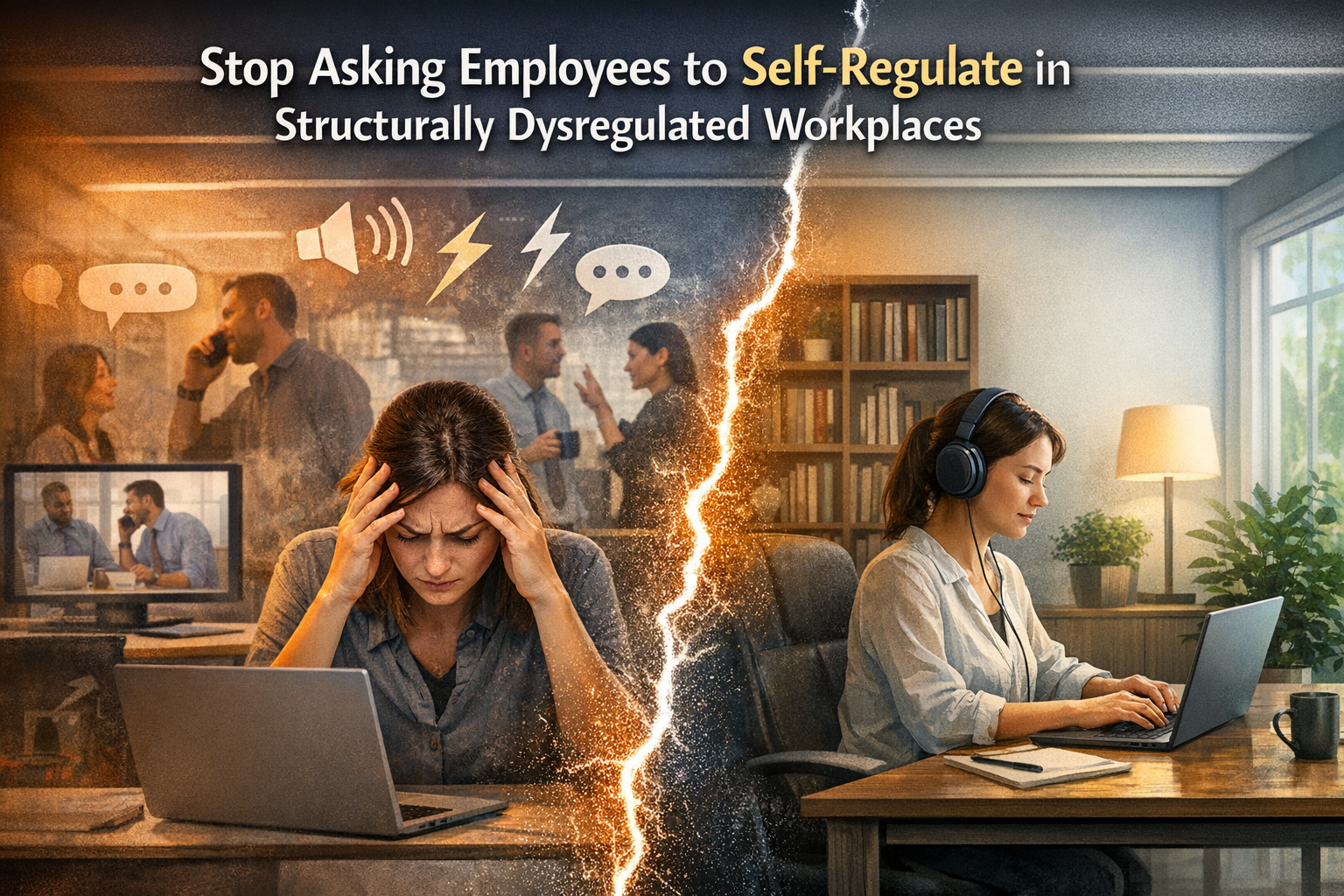
Stop Asking Employees to Self-Regulate in Structurally Dysregulated Workplaces
By Rose Byass
We have misunderstood psychological safety. It does not begin with trust-building workshops.
It does not begin with culture statements.
It does not begin with resilience training. It begins with environmental design. If the physical workplace chronically activates the human stress response, no amount of values-based messaging will create sustainable psychological safety. Leaders cannot expect regulated, high-functioning teams inside structurally dysregulating systems. And yet many modern workplaces do exactly that. Open-plan offices.
Hot desking.
Unrestricted desk-based video meetings.
Persistent conversational noise.
No acoustic governance.
No sensory zoning. We have normalised environments that the nervous system interprets as unpredictable and intrusive — then we question why people are fatigued, irritable, withdrawn, reactive, or burned out. This is not about comfort. It is about neurobiology.
The Brain Is Built for Predictability
Contemporary neuroscience increasingly understands the brain as a predictive organ. The predictive processing framework (Friston, 2010; Clark, 2013) suggests that the brain is constantly attempting to reduce uncertainty and conserve energy by anticipating what will happen next. Predictability lowers metabolic demand.
Unpredictability increases vigilance. When employees have:
- A consistent workspace
- Stable proximity to core team members
- Clear behavioural norms
- Manageable sensory input
…the nervous system can down-regulate baseline threat detection. Hot desking removes that predictability. Each day becomes a series of micro-calculations: Who am I sitting next to?
Is this a safe person to speak freely around?
Will I be interrupted?
Is this noise transient or constant?
Can I focus here? Individually small. Collectively expensive. Chronic unpredictability elevates stress hormones such as cortisol (McEwen, 2007). Sustained cortisol exposure impairs prefrontal cortex functioning — the very region responsible for executive control, working memory, and complex reasoning (Arnsten, 2009).In other words: The environments designed to “increase collaboration” may be impairing cognitive performance at a neurological level.
Noise Is Not Neutral
Research consistently shows that open-plan offices are associated with increased distraction and reduced task performance (Kim & de Dear, 2013). Exposure to uncontrollable noise elevates physiological stress markers, including heart rate and adrenaline (Evans & Johnson, 2000).Speech is particularly disruptive. The human brain is wired to prioritise vocal signals. Even when we attempt to ignore background conversations, intelligible speech captures attentional resources automatically (Banbury & Berry, 2005). This phenomenon — the “irrelevant speech effect” — demonstrates that background conversation reduces working memory capacity and task accuracy. Now layer onto that:
- Desk-based Teams meetings
- Speakerphone calls
- Loud conversational styles
- Continuous interruptions
- No acoustic barriers
We are asking people to perform deep cognitive work while their auditory system remains in partial threat monitoring. Over time, this produces attentional fatigue, irritability, reduced emotional regulation, and increased interpersonal friction. We then mislabel these outcomes as personality flaws.
Psychological Safety Requires Sensory Safety
Amy Edmondson’s work on psychological safety emphasises that people must feel safe to speak up without fear of humiliation or retaliation. But psychological safety cannot exist without physiological regulation. When the nervous system is dysregulated, social threat detection increases. Ambiguity feels risky. Tone is misinterpreted. Neutral interactions feel loaded. Environmental instability erodes interpersonal trust. Leaders often invest heavily in communication workshops while ignoring the physical conditions shaping neural states before a word is spoken. If we know that:
- Chronic noise increases stress,
- Unpredictability elevates vigilance,
- Cognitive overload reduces executive functioning,
Then workplace design becomes a leadership and governance issue — not a facilities afterthought.
Stop Pathologising the Regulated Nervous System
When an employee says: “I’m struggling to concentrate in this environment.”
“The noise is stressful.”
“I feel constantly overstimulated. ”The common response is: “Wear headphones.”
“Book a meeting room.”
“Be more resilient. ”The burden shifts to the individual. This is backwards. Why is the most sensory-sensitive nervous system required to adapt to the loudest one? Why is regulation framed as personal coping rather than structural responsibility? Heightened sensory processing is not fragility. It often correlates with strong analytical ability, deep focus, and high cognitive precision — if the environment supports it. The issue is not sensitivity. It is environmental mismatch.
When Leaders Dismiss Environmental Stress
How leadership responds to environmental complaints is a diagnostic moment. Common reactions include:
- Minimisation (“It’s not that loud.”)
- Individualisation (“That’s just your preference.”)
- Pathologising (“You’re too sensitive.”)
These responses create secondary harm. The first stressor is the environment.
The second is the invalidation of the stress response. Research on psychological safety demonstrates that dismissal increases perceived interpersonal risk (Edmondson, 2018). When employees express discomfort and are minimised, the nervous system registers relational threat alongside environmental strain. Suppression is not regulation. Neurobiologically, emotional suppression increases sympathetic activation and reduces parasympathetic recovery. Over time, this leads to disengagement, irritability, and silence — not resilience. Validation does not require agreement. A leader can say: “I understand that this environment feels overstimulating for you. Let’s explore solutions. ”That single response shifts the nervous system from isolation to co-regulation. Psychological safety is confirmed through reaction — not rhetoric.
A Personal View
At networking events or the rugby, I appear extroverted. I engage comfortably in social environments. But at work, I require depth and concentration. After a severe concussion, my cognitive tolerance shifted. My brain demanded quieter, more predictable environments for research and complex analysis. It was not preference. It was physiology. In hot-desking environments, I often felt “out of sorts.” Fatigued. Irritable. Withdrawn. I did not initially have language for it. Many employees may be in similar positions — whether due to concussion, trauma exposure, burnout, or neurodivergence — yet lack the vocabulary to articulate what is happening internally. What does dysregulation often look like? Snapping.
Hostility.
Withdrawal.
Reduced patience. Sometimes what appears as attitude is actually neuro-dysregulation. Leaders should consider this before labelling behaviour as difficult.
The Cost of Ignoring Neurobiology
Chronic environmental stress contributes to what neuroscientist Bruce McEwen termed “allostatic load” — cumulative physiological wear from repeated stress activation. Elevated allostatic load correlates with:
- Burnout
- Mood disturbances
- Cognitive decline
- Reduced immune function
When organisations design environments that sustain low-grade vigilance, they increase allostatic burden across their workforce. This has operational consequences:
- Higher absenteeism
- Increased turnover
- Reduced innovation
- Elevated conflict
- Greater psychological injury risk
Environmental stress is foreseeable. That matters in governance and duty-of-care discussions. If predictable harm arises from structural design choices, mitigation becomes a leadership responsibility.
Noise Governance Is Leadership Work
It should not be controversial to propose:
- No speakerphone calls at open desks
- Mandatory use of meeting rooms for virtual calls
- Acoustic zoning
- Clear behavioural norms around volume
- Defined quiet work areas for concentrated tasks
Quiet spaces must not function only as overflow rooms for private conversations. They must be legitimate zones for deep cognitive work. Leaders must ask: What nervous system state does our workplace produce? Performance is state-dependent.
From Accommodation to Design Intelligence
The goal is not to eliminate collaboration. It is to design intelligently. Evidence-based workplace design should include:
- Stable team zones
- Sound-absorbing materials
- Structured collaboration rooms
- Sensory impact assessments
- Consultation on individual work styles
- Clear noise and meeting policies
Leaders should inquire: How do you work best?
What impairs your concentration?
What enables your highest quality thinking? These are performance questions — not indulgences.
Do Better
Businesses with open-plan offices must mitigate responsibly. Stop accepting loud speaker conversations as cultural norm.
Stop blaming the person who says, “I am stressed.”
Stop treating regulation as an individual burden. The nervous system is not a weakness. It is the operating system of performance. Psychological safety begins with sensory safety.
And sensory safety begins with leadership. We cannot ask employees to self-regulate in structurally dysregulated workplaces. If we want high performance, innovation, and sustainable wellbeing, we must integrate neurobiology into workplace design. Environmental safety is leadership work.