Leadership Successes and Failures: Why CEOs Must Remain Politically Neutral in the Workplace
By Rose Byass
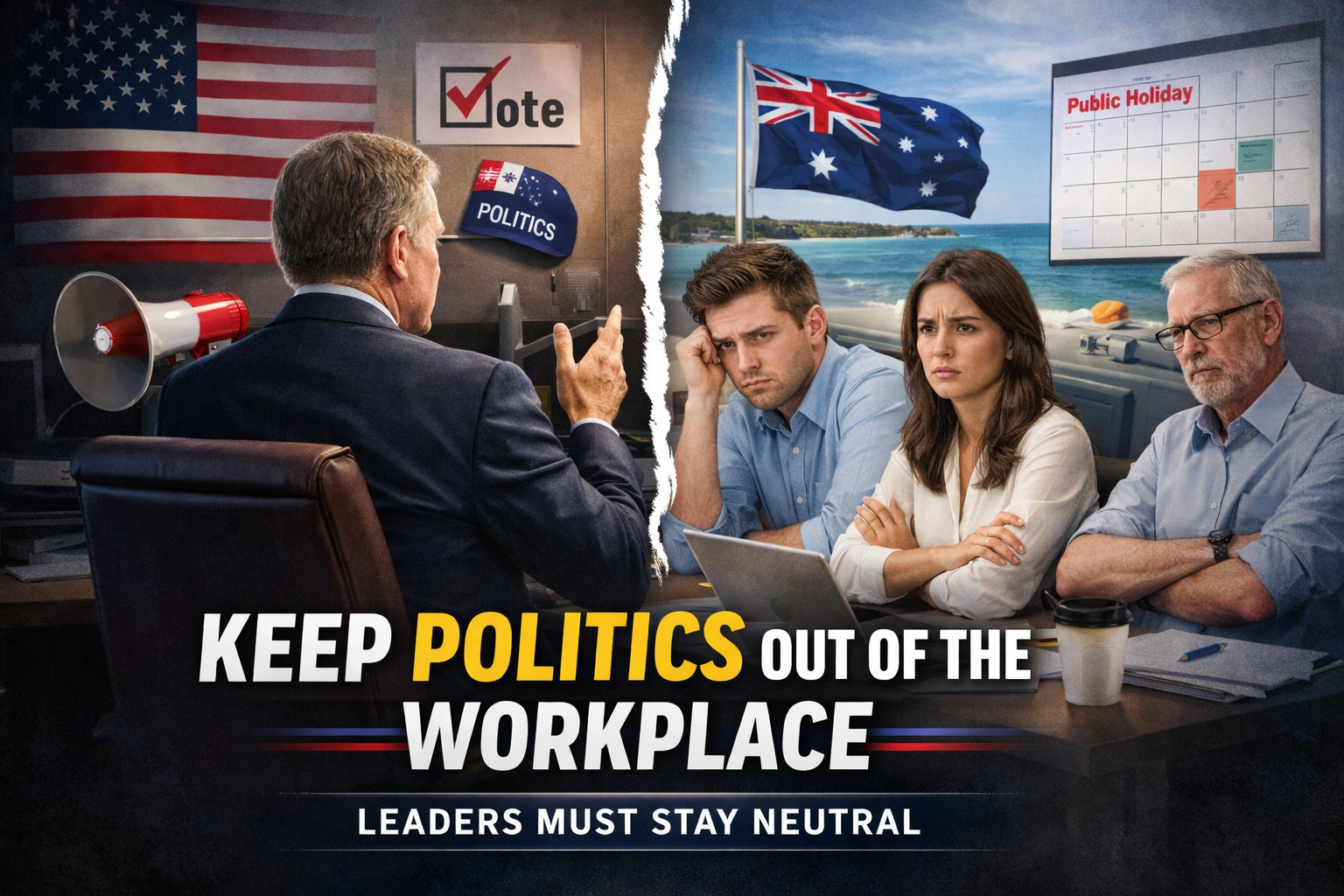
Leadership carries authority, influence, and legal responsibility. When exercised ethically, leadership builds trust, safety, and cohesion. When exercised through personal ideology, it can fracture culture, expose organisations to legal risk, and undermine employee wellbeing. In Australia, this distinction is particularly important when it comes to gazetted public holidays, including Australia Day.
Australia Day is a lawful, gazetted public holiday under state and territory legislation and is recognised under the Fair Work Act 2009. Regardless of personal belief, political position, or social sentiment, it is not optional in most workplaces. When a CEO or senior leader suggests that employees should forgo a public holiday because they personally align with the view that Australia Day represents “Invasion Day,” this is not simply an expression of opinion. It is the misuse of authority. It raises serious concerns under:
- The Fair Work Act 2009
- Work Health and Safety (WHS) legislation, particularly psychological safety
- Governance and ethical leadership standards
This article argues that while individuals are entitled to personal beliefs, leaders are not entitled to impose those beliefs—directly or indirectly—on employees. Doing so is not progressive leadership. It is inappropriate, unsafe, and potentially unlawful.
Australia Day: A Legal Fact, Not an Ideological Debate
Australia Day is a gazetted public holiday across all Australian states and territories. This means:
- Employees are entitled to the day off if it falls on their ordinary working day
- Employers may only reasonably request work in limited circumstances
- Where work is required, compensation and entitlements are clearly regulated
Whether a leader personally views the day as a celebration, a day of mourning, or something else entirely is legally irrelevant. The law does not operate on sentiment. It operates on statute. A CEO does not have discretion to reinterpret public holidays based on ideology.
When Personal Belief Becomes Workplace Pressure
A CEO suggesting that employees should work on Australia Day because she personally aligns with the view that it is “Invasion Day” creates immediate and serious problems. Even if framed as a “suggestion,” the reality of power imbalance means it cannot be viewed as neutral or optional. Employees hear such messages through the lens of authority:
- Will refusing affect how I’m perceived?
- Will this influence performance reviews or future opportunities?
- Am I being seen as politically misaligned?
This is not hypothetical. This is how coercion occurs without explicit instruction. Leadership speech does not exist in a vacuum.
Fair Work Act Implications
Under the Fair Work Act 2009, employees have clear protections relating to:
- Public holiday entitlements
- Workplace rights
- Freedom from adverse action
A leader encouraging employees to forgo a public holiday because of her personal political or ideological view risks breaching these protections. Key concerns include:
1. Unreasonable Requests
A request to work on a gazetted public holiday must be reasonable. Personal ideology does not constitute a reasonable business ground.
2. Workplace Rights
Employees have a lawful right to take a public holiday. Attempting to influence or discourage that right may constitute interference.
3. Adverse Action Risk
If an employee feels disadvantaged, marginalised, or treated differently for declining to work, the organisation may face adverse action claims—even if no explicit punishment occurs. Intent is not required. Impact is enough.
Psychological Safety and WHS Obligations
Under Australian Work Health and Safety legislation, employers have a positive duty to provide a workplace that is psychologically safe. Psychological safety includes:
- Freedom from intimidation or coercion
- Protection from ideological pressure
- Respect for diversity of views
- Safe expression of lawful boundaries
When a CEO introduces political or ideological beliefs into operational expectations, psychological safety is compromised. Employees may experience:
- Anxiety
- Moral distress
- Fear of reprisal
- Cultural or identity-based discomfort
This is particularly significant where the issue relates to national identity, history, or deeply personal beliefs. A psychologically safe workplace does not require agreement. It requires neutrality.
Why This Conduct Is Inappropriate — Even If Well-Intended
Some leaders justify such behaviour by claiming moral leadership or social awareness. However, ethical leadership is not measured by personal conviction. It is measured by restraint. A CEO is not acting as a private citizen at work. Their voice carries institutional power. When that power is used to:
- Promote a political interpretation
- Undermine a statutory entitlement
- Signal ideological preference
…it ceases to be leadership and becomes inappropriate influence. Good intentions do not neutralise poor judgement.
Leadership Failure: Confusing Advocacy With Authority
There is a critical difference between personal advocacy and professional authority. Leaders are free to engage in activism, political discourse, and advocacy in their private capacity. They are not free to repurpose the workplace as a vehicle for those beliefs. When leaders blur this line, several failures occur:
- Employees feel unsafe expressing difference
- Trust in leadership erodes
- HR and governance frameworks are undermined
- Legal exposure increases
This is not inclusive leadership. Inclusion cannot be built on ideological alignment.
Leadership Success: Neutrality as Professional Discipline
The strongest leaders understand that neutrality is not silence. It is discipline. Professional neutrality means:
- Upholding the law regardless of personal view
- Separating belief from authority
- Protecting employee rights
- Ensuring decisions are grounded in governance, not ideology
A CEO may personally support changing the date of Australia Day. That belief does not entitle them to override the law today. Leadership requires operating within the system while advocating for change through appropriate civic channels—not through workplace pressure.
Governance and Board Accountability
Boards have a duty to ensure that CEOs do not expose organisations to unnecessary legal and reputational risk. Failure to intervene when a CEO applies personal ideology to employment conditions may constitute a governance failure. Silence can be interpreted as endorsement. Good governance demands:
- Clear boundaries on executive conduct
- Reinforcement of legal compliance
- Protection of employee rights
The Real Harm to Workplace Culture
When employees perceive that ideological alignment is valued over lawful entitlement, culture deteriorates rapidly. Employees stop speaking up. Trust diminishes. Psychological safety erodes. And once lost, it is exceptionally difficult to rebuild. People do not leave organisations because of public holidays. They leave because they no longer feel safe.
Reframing Leadership Responsibility
Leadership is not about shaping employee belief. It is about protecting employee rights. CEOs are custodians of:
- Lawful employment practice
- Safe systems of work
- Organisational integrity
The moment personal ideology overrides these responsibilities, leadership fails.
Conclusion
Australia Day is a gazetted public holiday. That is a legal fact. A CEO encouraging employees to forgo that holiday because she personally aligns with the belief that it represents “Invasion Day” is acting inappropriately within the workplace context. Such conduct:
- Risks breaching the Fair Work Act
- Undermines psychological safety under WHS legislation
- Misuses positional power
- Damages trust and culture
Employees are entitled to hold their own views—whatever they may be—without pressure from those who hold authority over their employment. Leadership is not the freedom to impose belief. It is the responsibility to protect neutrality. And neutrality is not avoidance. It is professionalism. In modern Australia, that professionalism is not optional. It is essential.